


- Sado Archive
- Introducing spots where you can fully enjoy the history and nature of Sado Island
Introducing spots where you can fully enjoy the history and nature of Sado Island

Myōsenji Temple
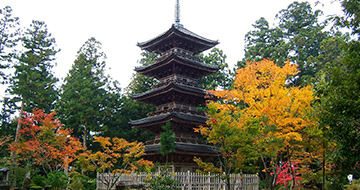
This thirteenth-century Buddhist temple embodies Sado’s history as a place of exile. Japan’s military rulers, the shoguns, often dealt with political rivals or dissenters by banishing them to remote islands such as Sado. Myōsenji Temple belongs to the Nichiren school of Buddhism, whose founder, Nichiren (1222–1282), was banished to Sado from 1271 to 1274 for his criticism of the shogunate. During that period, Myōsenji’s first abbot, Abutsubō Nittoku (d. 1279), became a follower of Nichiren together with his wife, Sennichi-ama, a Buddhist nun. The temple’s treasures include the oldest-known wooden statue of Nichiren, carved in 1274, and an original letter from Nichiren to Nittoku.
The abbot Nittoku first arrived on the island as part of a military escort for Emperor Juntoku (1197–1242), who spent the last two decades of his life exiled to Sado. In 1221, Juntoku had been implicated in an attempt to overthrow the Kamakura shogunate (1185–1333) and restore direct imperial rule. The emperor was forcibly moved to Sado as punishment. Nittoku came to the island as a samurai, but he later renounced the world and became a monk.
A century later, a revolt by another emperor, Godaigo (1288–1339), produced a fresh wave of exiles to Sado. One of Godaigo’s supporters, the courtier Hino Suketomo (1290–1332), spent a total of seven years on Sado before he was executed for his loyalty to Godaigo. His grave is located at the temple.
Myōsenji’s five-storied pagoda is unique within Niigata Prefecture. The pagoda was constructed over a 30-year period, under two generations of master builders, and was completed in 1825. According to temple lore, although the pagoda has five stories, the magistrate’s office had only granted permission to the abbot Nittai (1764–1831) for three stories. To make matters worse, Nittai was later accused of conducting prayers that did not align with the teachings of Nichiren Buddhism. For this offense, the abbot was removed from Myōsenji Temple and sent to a much smaller branch temple elsewhere on the island. In this way, he became another of Sado’s many exiles.
Daizen Jinja Shrine and Noh Stage
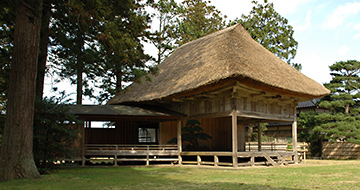
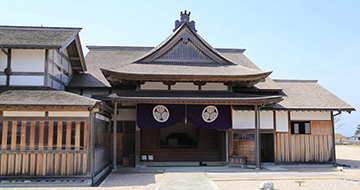
This thatched roof structure tucked behind a rustic Shinto shrine on the south side of the city is the oldest extant Noh stage on Sado Island. The stage was built in 1846, but Noh plays have been performed at this site since 1823 and are still performed here every year. Traditional torchlit performances called “Takigi Noh” are held at the shrine in early June. The rear of the stage is decorated with an image of a pine tree, a standard motif in Noh, but the addition of a red disc representing the sun is unique to Daizen Jinja Shrine.
Daizen Jinja’s Noh stage has been adapted to fit the space available at the site and is slightly smaller than the standard 5.5 meters square. As a result, the stage’s layout has been made more compact: actors access the stage by crossing a long bridgeway from the dressing room. The bridge is both part of the stage and separate from it, and each actor’s exit or entrance is a crucial part of the performance. Normally, this bridgeway is long and straight, but here it doubles back on itself, putting the dressing room directly behind the stage. During performances, the two parallel sections are separated by a hanging curtain.
Daizen Jinja honors Miketsu no Ōkami, a deity of food and bountiful harvests. A subsidiary shrine in a secondary building is dedicated to the spirit of the mountain mystic Daizenbō, who was executed in the 1330s for his part in a violent political intrigue. Daizenbō is said to have helped a Kyoto courtier escape from Sado after he tried to murder the island’s magistrate. A descendant of the magistrate ordered the shrine built to placate Daizenbō’s angry spirit.
An Island of Noh Actors
Noh has deep roots on Sado. Zeami Motokiyo (c. 1363–1443), one of the art form’s founding playwrights, was exiled to the island in 1434 after a falling-out with the shogun. But Zeami returned without spreading his art, and it wasn’t until the early 1600s that Noh’s local popularity exploded. In 1604, a magistrate with a background in theater was sent to the island to oversee the local gold-mining operations. He had a stage built and sent for a troupe of actors and musicians from the mainland to perform for him. In just a few short years, Noh became the local pastime. Even tiny communities of just a dozen households were recorded as having their own stages and amateur troupes. At its peak, Noh was performed at over 200 stages on Sado, most of them attached to Shinto shrines. Thirty-four of those stages survive today.
Seisuiji Temple
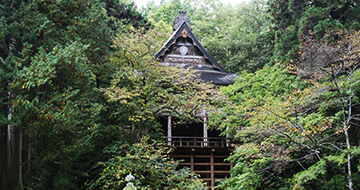
The approach to this ninth-century Buddhist temple leads up a path of stone steps lined with 500-year-old cedar trees. Its impressive but dilapidated main sanctuary looks out over the 15 buildings of the temple complex and a pair of 24-meter ginkgo trees.
According to an old Sado legend, in 805 Emperor Kanmu (735–806) sent a Buddhist monk to establish a new temple on Sado. As the monk traveled through the wilderness, he spotted something shining in a nearby river. He followed the water to its source, and there he spent a night at the foot of a pine tree. When he awoke the next day, a heavenly child stood before him. The child told him to build a temple where he lay, and that became the origin of Seisuiji. The temple was completed in 808.
The name “Seisuiji” is written with Chinese kanji characters that mean “pure water.” Seemingly by coincidence, it shares these characters with Kiyomizudera Temple in Kyoto. (Although Kiyomizudera is better known by far, Seisuiji was founded first.) The two temples share other connections as well: Seisuiji’s current main hall dates to 1730 and is the oldest building at the temple. It is perched on a hillside overlooking the grounds, and a wooden platform extends from the front of the hall, supported by tall pillars. This design closely resembles the famous stage at Kiyomizudera. The hall’s primary image is a statue of the thousand-armed manifestation of the bodhisattva Kannon, a deity of compassion. This statue is said to be a replica of the statue at Kiyomizudera.
Former Aikawa Detention Center
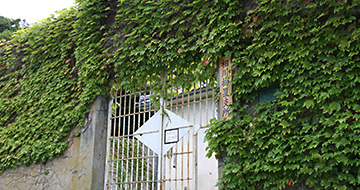
Ivy-covered concrete walls and a rusting gate enclose an old jailhouse at the top of Aikawa’s historic hillside Kyōmachi neighborhood. Aikawa Detention Center shut down in 1972, having served as a local branch of the Niigata prison system since 1954. Today, it stands empty and silent. Visitors are free to unlatch the bolts at the top and bottom of the door and go inside. The interior is clean and bright, lit by skylights and large windows, yet it feels eerily frozen in time. The concrete hallways and weed-ridden yard are quiet and peaceful. No guards stand outside the security doors, and no inmates pace the tatami-floored cells whose doors lie open and inviting.
The jail’s main detention wing comprises six cells, one of which was reserved for women, in addition to a bath, a kitchen, and a library. Offices and a visitation area are found in the smaller entrance wing. The jail could hold 18 detainees at a time. Most were suspects awaiting the results of their trials, but the kitchen was staffed by convicts. A police station and a courthouse were located nearby.
Few jailhouses of this age and type remain in Japan, and Aikawa Detention Center has been nationally registered as a Tangible Cultural Property. Visitors can linger in the jailhouse as long as they like, provided they lock the front door again when they leave.
Historic Kyōmachi Street
The discovery of gold near Aikawa in 1596 transformed what had been a small seaside village into a boomtown of 50,000 residents. At the height of the town’s prosperity, this avenue had a thriving nightlife to rival even the pleasure districts of Kyoto.
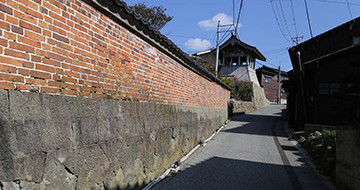
Kyōmachi Street runs through the heart of old Aikawa, connecting the magistrate’s office in the west to the mine entrance in the east. The wooden houses that line the street today were mostly built in the early twentieth century, after the mine was sold to Mitsubishi Gōshi Kaisha (now the Mitsubishi Corporation). The well-preserved row houses that line the main road were formerly company housing for mine workers, but today they are mostly private residences.
The gold rush attracted people from all walks of life, and many of the old neighborhoods are still named for the occupations of their former inhabitants, such as “salt-maker district” (shioya-chō), “miso-maker district” (misoya-chō), or “grocer district” (yaoya-chō). Even the name “Kyōmachi” (literally, “district of the capital”) was coined when a clothier began selling fabric from Kyoto’s famous Nishijin textiles district.
A walk down Kyōmachi Street can feel like a journey back to an era when gold flowed from the hills and Aikawa was a company mining town. Summer evenings are especially atmospheric. During the Yoi no Mai festival in early June, residents in traditional garb parade through the lantern-lit street, dancing to Aikawa Ondo folk music. An antique bell tower, built in 1712 and restored in 1860, still rings to mark the start and end of each day.
Sado Magistrate’s Office
Sado’s mineral resources were a great source of power for the Tokugawa family, the dynasty of shoguns who ruled Japan during the Edo period (1603–1868). The Tokugawa family took control of Sado in 1600, just as the Aikawa gold rush was getting underway. When the Tokugawa shogunate was formally established in 1603, the shogun wasted no time in establishing formal administration of Sado and the island’s gold mines. The island was put under the management of a magistrate named Ōkubo Nagayasu (1545–1613). The following year, a spacious residential compound was built for Ōkubo and the magistrates who would succeed him.
From this large compound, the magistrate governed Sado and oversaw the mining and minting operations. The compound burned down several times during the centuries since its construction, and in 2000, Aikawa gathered a team of specialists to recreate several of the wooden structures as they had existed in 1859. The designs were based on old drawings and written records, along with archeological evidence. The rebuilt area includes the compound’s main gatehouse, certain administrative and judicial facilities, storage buildings, and an ore-dressing workshop.
A notable feature of the central building complex is a pair of enclosed courtyards where the magistrate and his deputies presided over local court cases. Petitioners and criminal suspects knelt in the yards below while the officials who pronounced judgment sat above, looking down from raised tatami-mat rooms.
Visitors can try lifting a 41-kilogram slab of lead, one of 172 rough oblong slabs that were excavated from the southern side of the complex. Lead was (and still is) used to extract gold and silver through a process called cupellation, and the slabs were kept on hand for this reason. Local records suggest that two stockpiles of lead had been buried for safekeeping in the late 1600s, but when workers at the complex went to dig them up in 1718, some of the lead went undiscovered. The slabs were finally discovered over two centuries later, in 1995.
Ōkubo Nagayasu and Sado Noh
Ōkubo was appointed the first administrator of Sado, but unlike many appointed officials of the time, he did not come from a samurai family. His father and grandfather were performers of sarugaku, a comic predecessor to Noh theater. But Ōkubo had managerial talents that brought him to the attention of powerful patrons, including Tokugawa Ieyasu (1543–1616), the first of the Tokugawa shoguns. Ieyasu put him in charge of developing several gold and silver mines around Japan.
Despite his magisterial duties, Ōkubo stayed connected to his theatrical roots. In 1605, he had a Noh stage built on the island and invited a troupe of actors and musicians from the mainland to perform. Noh’s popularity spread from there: at its peak, there were some 200 stages on Sado, most of them attached to Shinto shrines. Of these, 34 stages remain today.
Ōnogame
Ōnogame, “the great turtle,” is an enormous rock that juts out of the sea near the northern tip of Sado Island. The headland monolith is a single massive slab of dolerite that rises 167 meters from the water. It is the largest geological feature of its kind on Sado. Visitors can admire its profile from the adjacent park or hike the dirt path to the top (a climb of about 30 minutes) for an unmatched view of the coastline and surrounding waters. Less arduous walking paths start at Ōnogame’s base and lead along the nearby cliffs.
Ōnogame was created around 20 million years ago. Deep below the ground, a pocket of magma formed, cooled, and was gradually pushed to the surface by tectonic activity. The igneous rock was then slowly exposed by erosion, leaving a monolith that has been an object of veneration for millennia. The name “Ōnogame” contains the word for “turtle” (kame), but it may originally derive from the Ainu word for “god” (kamui). Some experts believe Sado’s prehistoric inhabitants traded beads and other goods with indigenous Ainu people from the mainland, and the rock’s name is thought to support that theory.
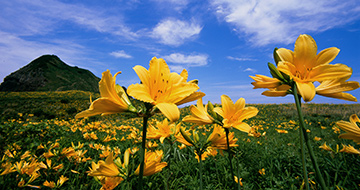
The area around Ōnogame is known for the dense fields of yellow-orange Amur daylilies (Hemerocallis middendorffii var.) that bloom on its slopes from late May until early June. The Sado Kanzō Festival, held nearby on the second Sunday of June each year, features folksongs and ondeko drumming by dancing, demon-masked performers.
Donden Highland
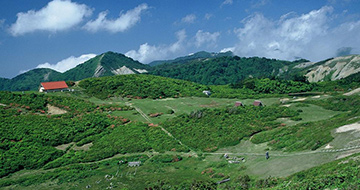
These rolling highlands, located about 900 meters above sea level, are favored by hikers and wildflower-lovers. A huge variety of flowering plants, many of which grow only at much higher elevations on the mainland, bloom here from March through October. Visitors can take in views of the surrounding valleys and the Sea of Japan, or hike the highland’s accessible network of trails, with routes ranging from two-and-a-half hours to seven hours long. Accommodation is available at the Donden Highland Lodge.
The tallest peak of the highland is Mt. Tadaramine (934 m), popularly called “Mt. Donden.” The strong winter winds at the peak stunt the growth of trees, leaving the area grassy and open. The harsh winters may also be responsible for the so-called “summit effect” of the highlands, where it is possible to find alpine plants that normally grow at elevations of 1,500 meters or more.
Sado’s official mountain wildflower calendar lists more than two dozen species among the highlands, including purple-white Japanese hepatica (late March through April), dogtooth violets (April and May), and yellow-spotted Euphrasia insignis (mid-September to late October). Visitors are asked to help protect the environment by limiting flower-hunting to photography. (No picking, please.)
-
 Mountains Plants
Mount Donden
Mount Donden, officially named Mt Tadaramine, is the whole highland area including three mountains above 900m. As the nickname,originated from the word "donden", which means roundtop mountain, indicates, Mount Donden is located at the heart of steep Osado Mountains and solely appears with modest inclines among the mountains. The surrounding area is a treasury of alpine plants and wildflowers. Mount Donden is one of the new Top 100 Mountains and TOP 100 Mountains of Flowers in Japan and many trekkers visit there from April towards early Summer.
-
 Government-run Facilities Other
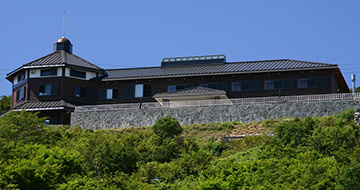
Donden Highland Lodge (mountain lodge)
Donden Sanso, situated right in the middle of the traverse course on Osado Mountains, has been loved by hikers and tourists who visit Osado Mountains such as Mt Donden, one of the Top 100 Mountains with Flowers in Japan. Seafood, riches of the soil special to Sado, and delicious rice are popular among visitors. The view from the deck is stunning, and you can look out to the mountain ranges in Echigo on the mainland when the weather is clear. Sunrise and starry night skies are also fantastic.
Hakuundai Lookout
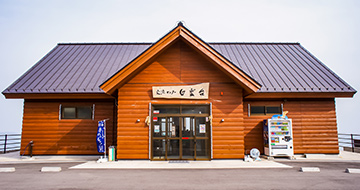
This small visitor center is the ideal vantage point from which to take in the full expanse of Sado Island. It also offers access to the hiking trails of the Ōsado mountain range. The facility, situated about 850 meters above sea level, consists of an observation deck and a building where visitors can buy souvenirs and snacks. Vehicle access via the Ōsado Skyline Road is open only during the warmer months, when the roads are clear.
Few spots on Sado are better than the Hakuundai Lookout for taking in the island’s distinctive geography. Sado’s two parallel mountain ranges, Ōsado and Kosado, emerged from the sea as neighboring islands some three million years ago before being slowly connected by sediment that accumulated between them. From Hakuundai, visitors can see the whole Kuninaka Plain, including Ryotsu Port and Lake Kamo, as well as the mountains of the Kosado range beyond them and the Ogi Peninsula to the far southwest.
Hakuundai anchors one of Sado’s most popular trekking trails, the 13.6-kilometer Donden Highland to Hakuundai Traverse Route. The roughly seven-hour route alternates between woodlands and open ridges, passing under Sado’s highest peak, Mt. Kinpoku (1,172 m), which is also visible from the lookout.
-
 Mountains
Exchange Centre Hakuundai
Hakuundai is a lodge-style building standing at about 850 metres above sea level. The viewing terrace offers a stunning panoramic view across Sado, including Ryotsu Bay, Kuninaka Plain and Ogi Peninsula. At the souvenir shop inside the building, you will find Sado specialties, such as "Okesa persimmon butter", "fig jam", and "wild grape wine". Curry over rice with the Island's black Berkshire pork, and soft ice cream made from fresh cream are special menu items at the light meal corner. Hakuundai is closed for winter as Osado Skyline will be closed due to snow.
-
 Mountains Plants
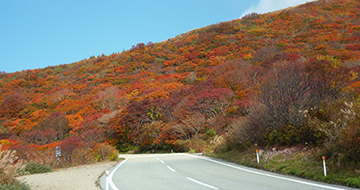
Osado Skyline
Osado Skyline is approximately 30km-long route for a scenic drive between Kanai and Aikawa. The highest point is above 900m, and you can look over the entire island, from Mano Bay, Ryotsu Bay, Kuninaka Plain to Kosado Mountains. The view from Hakuundai, a rest area with a viewing deck, is stunning. The scenery in each season such as fresh foliage in early summer and red leaves in autumn is a must-see.