


- View
- History & Places of Interest
- Sightseeing
- Experience
- History & Places of Interest
- Nature/Scenic Spots
-
 Other
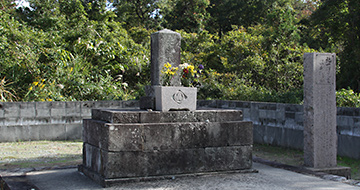
OtherA gravesite of Kita Ikki
Shokoji Temple, close to Kita' birthplace in the Ryotsu Minato area, is a temple for deceased ancestors of the Kita family. His tomb is situated in the Aoyama Cemetary of Shokoji Temple, overlooking the rural landscape of Harakuro (Shiizaki). Although Kita Ikki was a leading thinker and socialist from the Meiji to early Showa times (early 20th century), many people still visit and lay flowers on his grave.
Ryotsu area -
 Folklore
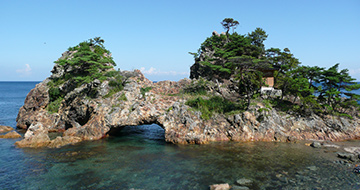
Akagameiwa Rock
Akagameiwa is a big, red stone of iron quartz, which can be seen from a bathing beach in Akagame Kazashima Nagisa Park. The rock has a hollow in the middle, and the shape resembles to parent and child nestling up together. "Once upon a time, when a fisherman in Suizu encountered a turbulent sea, a big turtle appeared, and the fisherman and his boat rode on the turtle's back and returned to the port. The turtle turned into a rock, and villagers named the rock "Akagame". The rock has this folk story, and there is a shrine to enshrine Akagame Myojin god.
Ryotsu area -
 Shrines and Buddhist Temples
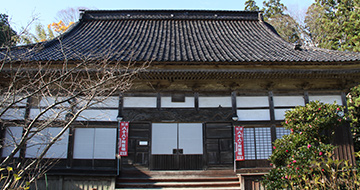
Choanji Temple
Located in the Kujikawachi village, Choanji Temple is said to have been founded in 831, and has a wooden seated statue of Amitabha and a bronze bell in its storehouse, both of which are designated as Japan's Important Cultural Properties. The statue is said to have been made in the late Heian Period (the 12th century). The bronze bell was pulled up from the bottom of the sea in Wakasa (present-day Fukui Prefecture) around the 13th century, and it is said to have later been dedicated to Choanji Temple. It is one of the forty-seven so-called Korean bells still in existence in Japan, and this is the only one of its kind in Niigata Prefecture. It is 107.5 cm tall and 61.2 cm diameter. The elaborately designed dragon-shaped handle at the top of the bell and the arabesque pattern are striking.
Ryotsu area -
 Shrines and Buddhist Temples
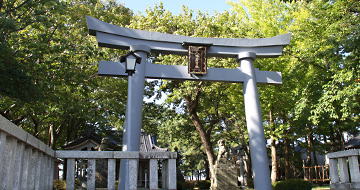
Hachiman Wakamiya Shrine
Called "Wakamiya-san", Hachiman Wakamiya Shrine is familiar to locals in the Ryotsu Minato area. Every year on the 5th of May, Minato Matsuri, the most important annual festival at the shrine, takes place. Along Wakamiya Street, fisherman's good-haul banners (used to indicate a good catch) are hoisted and flutter, and a mikoshi (portable shrine) is carried, bounced and shaken through the street in a wild procession. It is a distinctly heated, port-town festival. Within the grounds of the shrine, along with the Main Hall, there is a hall enshrining Tenmanten Shrine, Izumo Taisha Grand Shrine and Otokai Shrine together, and a monument built in memory of the Kita brothers, Ikki and Reikichi.
Ryotsu area -
 Shrines and Buddhist Temples
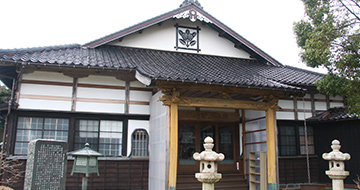
Hongyoji Temple
Matsugasaki is said to be the place where Nichiren Shonin arrived on Sado. Hongyoji Temple was established by Futsujubo Nichiryo (Buddhist monk who was a strong believer of Nichiren) to commemorate the Nichiren's first step on Sado. Within the grounds, you can see the stone statue of preaching Nichiren Shonin, and a large tree of Japanese zelkova (kayak in Japanese) called "Okeyaki", under which Nichiren kept the night dew out after landing on Sado.
Ryotsu area -
 Heritage and Relics
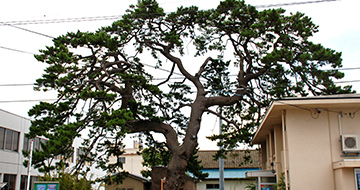
Murasame no Matsu (rain-showered pine)
Within the grounds of Sado Japan Coast Guard Station, a Japanese black pine tree with beautifully shaped branches stands nineteen metres tall, and has a girth of six metres. It used to be a navigational aid for maritime pilots at sea, and is mentioned in the folk song, "Ryotsu Jinku". Murasame no Matsu used to be called "Otabisho no Matsu" (a pine tree at the midway resting point of a god during a procession), or "Gobansho no Matsu" (a pine tree at a port observation post). Koyo Ozaki, a novelist who visited Sado in the Meiji times (1868-1912), thought the tree getting splashed by waves resembled the wetness of getting caught in a shower of rain (called "murasame" in Japanese). The tree's name is derived from this episode. Murasame no Matsu is a Niigata Prefecture Natural Monument.
Ryotsu area -
 Shrines and Buddhist Temples Noh Stages
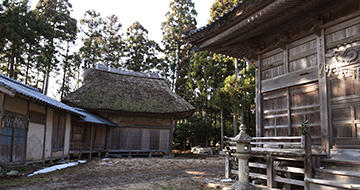
Nagae Atsukushihiko Shrine Noh Stage
The shrine's tutelary forest is located in the middle of a vast rice field to the south of Nagae River, and its lion-dog statues standing in the paddy are an impressive scenic feature. Established in the early 9th century, Nagae Atsukushihiko Shrine is one of Sado's nine shrines included in the Engishiki Register. After being moved, the current buildings are said to have been constructed in 1714. This shrine houses the tutelary deity for the Kamo Clan as well as a god of mines that used to be enshrined at Mt. Kinpoku. Within the shrine compound, a Noh stage with a quaint thatched roof stands with its left side facing the main hall. The stage is comprised of a main stage area and a rear stage area, and the passageway connects the stage and the room behind the curtain. Estimated to have been built between 1764–1780, this Noh stage is thought to be a valuable example of few pre-modern structures on Sado, and is designated a City Cultural Property.
Ryotsu area -
 Other
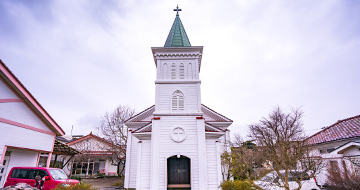
OtherRyotsu Catholic Church
Christianity is considered to have been brought to Sado first in the Edo Period (1603-1867). Ryotsu Catholic Church was founded by a French Christian missionary, Fr. Drouart De Lezey. It was burnt down once in 1883, but was reconstructed by a missionary, De Noailles, in 1887. The church building was designed by Father Papino, who designed many churches in Japan.
Ryotsu area -
 Other
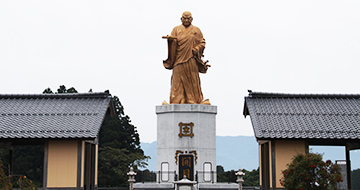
OtherSado Nichiren Shonin Daidozo (Huge Bronze Statue)
This bronze statue of Nichiren (founder of the Nichiren School of Buddhism and an exile to Sado) was erected as a result of the concerted contribution of over 3,000 monks and followers all around Japan, and as a part of a celebration for the 750th anniversary since the establishment of the Nichiren School. With Ryotsu Bay as its backdrop, the statue stands facing India, the Buddha's birthplace, at approximately 13 metres high (26 metres including the base). The statue appears with a great dignity well-suited to Sado, which is closely related to Nichiren.
Ryotsu area -
 Heritage and Relics
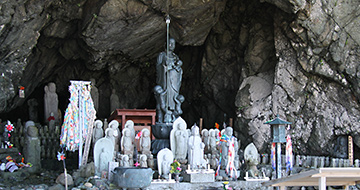
Sai-no-Kawara
Along the walking path connecting the unique rock outcrops of Onogame and Futatsugame, a ten-minute walk from the Negai village will lead you to Sai-no-Kawara. In a marine cave, countless stone Jizo (the guardian deity of children) statues stand still, centred around Jizo Bosatsu. Sai-no-Kawara is considered to be the bank area of a river, which flows at the boundary of life and the afterlife. It is where the spirits of deceased children are thought to go, and it has been a sacred space since the olden days.
Ryotsu area -
 Folklore
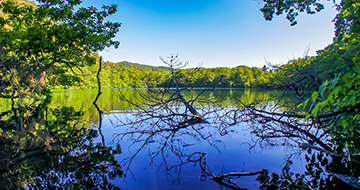
Sankyo no Ike
Sankyo no Ike is located closed to Komyobutsuji Temple, where a buddhist monk Tanzei Shonin stayed for six years, located at upper stream from the Masaragawa area, 340m up in the mountain. The circumference of the lake surrounded by a thick bunch of trees is 500m. You can walk around the lake along a promenade. A legendary tragic love story of the male dragon, the master of the lake, and a beautiful girl named Osen has been retold from generation to generation. The stream of Ozare River, fed by water of this Sankyo no Ike, becomes Waterfall of Ozare, to flow into the sea around the Masaragawa area in Sotokaifu.
Ryotsu area -
 Shrines and Buddhist Temples Noh Stages
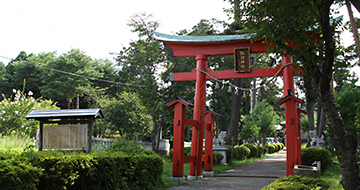
Shiizaki Suwa Shrine
Shiizaki Suwa Shrine is perched on a hill overlooking Lake Kamo. It was built in 1376, as a shrine to where the god divided from Suwa Taisha, in Nagano Prefecture, was invited and reenshrined. It is, reputedly, a guardian god for the Kujihonma family, the neighbourhood manor's lord. The Noh stage, with its gable-style tiled roof, was built in 1902 (a Niigata Prefectural Tangible Cultural Asset) and hosts the largest number of Noh performances in Sado. Atmospheric bonfire Noh performances are held on Saturdays, from May until early October (excluding August). You can join workshops of Noh and shimai (a simplified version of Noh, which is danced/performed to jiuta songs).
Ryotsu area -
 Noh Stages
The Honma Family's Noh Stage
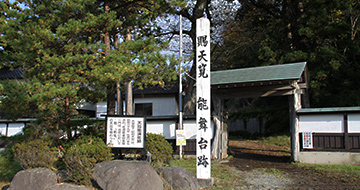
Holding status as the centre of Noh in Sado is the Honma family, present-day grand master and the 18th head of Sado Hosho School. They have been playing a vital role in the promotion and popularization of Noh. Reconstructed in 1885, the Noh stage with its hipped, tiled roof (a Niigata Prefectural Tangible Folk Cultural Asset) has clay pots set under the floor to create good sound effects during performances. It is the most authentic among others in existence in Sado, and the only one that is privately owned. Regular Noh performances are held on the last Sunday in July every year.
Ryotsu area -
 Shrines and Buddhist Temples
Tsugami Shrine
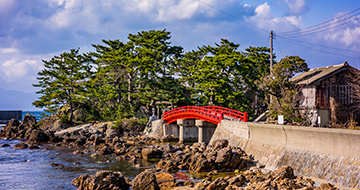
The Okawa village on the east coast of Sado thrived as a port of merchant shipping during the Edo Period (1603-1867), with shipping agents standing side by side. Tsugami Shrine, a mainstay of this village, houses two well-worshipped deities, a god of safety for vessels on the kitamaebune western shipping route, and a god of good commerce. Tsugami Shrine used to be situated behind the village, and was reputedly relocated to where it now stands sometime before the Genroku era (1688 - 1704). Farther beyond the red Tsugami bridge, the main hall lies and enshrines the sea gods of Sumiyoshi.
Ryotsu area