


- View
- History & Places of Interest
- Sightseeing
- Experience
- History & Places of Interest
- Nature/Scenic Spots
-
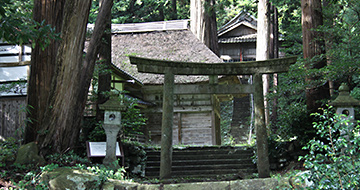 Shrines and Buddhist Temples Noh Stages
An'yoji Haguro Shrine
An'yoji's Haguro Shrine is said to be a shrine to where the god divided from Haguro Shrine, in Yamagata Prefecture, was invited and re-enshrined in 772. It is surrounded by gigantic cedar trees, and the main hall lies in harmony with the surrounding lush woods. Since olden days, in the small village of An'yoji, Noh has been offered in place of Ondeko (deity mask dance) in the annual, most important festival. The Noh stage (a Niigata Prefectural Tangible Cultural Asset), with its thatched, hipped-roof, is reputed to have been built in the late Edo Period (19th century). It used to stand across the front path from the main building of the shrine, but around 1909, it was relocated to, and enlarged, on the site where it now lies. The Noh stage at Haguro Shrine is the smallest in Sado, among the ones still in existence.
Kuninaka area -
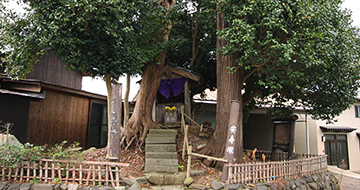 Folklore
Anjuzuka (Memorial Mound of Anju in Hatano)
Two different versions of the folk tale "Anju and Zushio" have been passed down from generation to generation in Sado. Hatano is arguably the place where Anju passed away while on her way to Kyoto, after she and her brother had a reunion with their mother. This mound is said to be the burial place of some of her mementos such as her favorite comb. It has been worshipped for good harvests, and for miracles in finding a partner and healing eye diseases. Anju Tenjin Festival takes place every summer.
Kuninaka area -
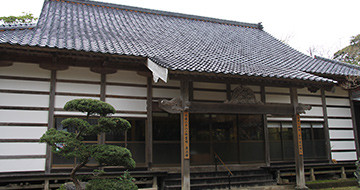 Shrines and Buddhist Temples
Chikoubo Temple
The historic old temple of Shingon School welcomes you with brilliant sculptures. It is said that the temple was established by Kuzan, a Buddhist monk, in 808, and the main object of worship is a1,000-armed Kannon Bosatsu (Guanyin: Goddes of Mercy). Seen on the sculpture of Sanmon Gate, Ebisu is the god of driving evil spirits away and bringing luck in. It has been greatly worshipped as a god of fishing and safety at sea to this day. The hall enshrining Konpira Gongen, a god of sailors, was founded in 1833 by Jinzaemon Takano, a master carpenter in the Murayama area. You will be overwhelmed by the sculpture, which richly embellishes the hall. Mahori Hogan Yoshitaka, a master artist, donated his painting entitled "Kurasaki Ebisuten" to this temple.
Kuninaka area -
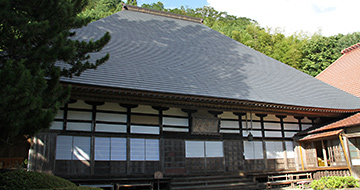 Shrines and Buddhist Temples
Chokokuji Temple
Founded by Kobo Daishi (Kukai) in 807, Chokokuji Temple is an ancient temple which imitates Hasedera Temple in Yamato (present-day Nara Prefecture). The temple is where Zeami paid a visit after landing on Sado Island, and he mentioned the temple in his book Kintosho (Writings of the Golden Isle). The temple is also known as a temple of flowers, including peony. Chokokuji Temple owns a large number of cultural assets which shadow living history, varying from three Eleven-Headed Kannon Statues (National Important Cultural Properties), to statues of Kongo Rikishi (two wrath-filled guardians of the Buddha) made in the Heian Period (10th-12th centuries), as well as Gochido Hall. Within the grounds, there are also three cedar trees and Japanese Umbrella-pine trees, both of which belong to Niigata Prefecture's Natural Monuments.
Kuninaka area -
 Shrines and Buddhist Temples
Dainichido
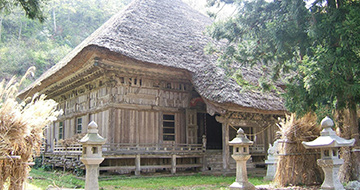
Dainichido is a worship hall in Ohirume Shrine, which is considered to have been established in 1490. The existing building (a Niigata Prefecture's Designated Tangible Cultural Asset) was reputedly reconstructed in 1718. The hall enshrines a statue of Seated Dainichinyorai (Vairocana), considered to be created by Mokujiki Seigen. Seen as a place of worship for a tutelary deity of cows, in the past, cowherds from all over the island traveled on foot with their cows, to pay visits to Dainichido. Many ema (wooden plaques with prayers written down on them) with pictures of cows, and waraji (straw sandals) for cows are dedicated to make wishes come true.
Kuninaka area -
 Shrines and Buddhist Temples Noh Stages
Daizen Shrine
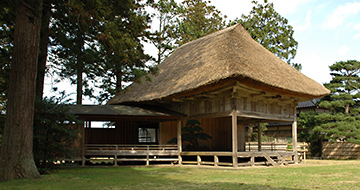
Daizen Shrine sits in a rustic setting resembling the landscape of Asuka in Nara Prefecture. Honma Yamashironokami, the manor's lord, initiated the enshrinement of Suketomo Hino (an exiled court noble) and Daizenbo (an ascetic hermit) together, while Miketsuokami (the god of food) is enshrined at the main building. When Kumawakamaru, the son of Suketomo Hino, came over to Sado to revenge his father's death by execution, Daizenbo helped him escape and was, consequently, executed. This shrine reputedly houses Daizenbo in order to calm his revengeful ghost. Reconstructed in 1846, the Noh stage with its thatched and hipped roof (designated a Niigata Prefecture Tangible Folk Cultural Asset), is one of the four Noh stages in the Kuninaka area where Noh performances were regularly held. It is said to be the oldest Noh stage still in existence in Sado. At present, Noh performances are offered at a festival on the 18th of April; and in June, Noh and Sagi School's Kyogen performances take place.
Kuninaka area -
 Other
OtherGigantic Straw Sandals in Kuratani
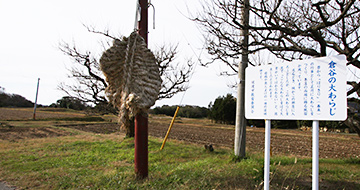
People in Okuratani, in the Mano area, have been passing down the tradition of making gigantic straw sandals for New Year's, to hang at both ends of the village in early spring. Acting as guardian deities to protect the community from troubles and evil, the huge straw sandals are displayed to pretend that there is a giant man in the village. The sandals are replaced with new ones every March. If you travel along Route 350, you can see them, measuring about 1 meter wide and 1.8 meters long.
Kuninaka area -
 Shrines and Buddhist Temples
Hiyoshi Shrine
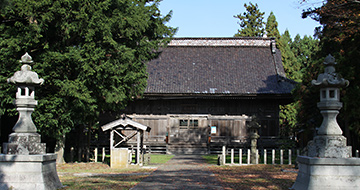
Hiyoshi Shrine is familiar to locals, and known as "Sanno-san". The shrine was established in 1226 for Emperor Juntoku, who was banished to Sado, after his high ranking servant, Kiyonori Ike, initiated dividing and re-enshrining the god enshrined at Hiyoshi Taisha Shrine in Omi (present-day Shiga Prefecture). Many wooden and stone statues of monkeys, messengers of a god, can be seen around the grounds of the shrine. The statues include the "three wise monkeys", which are Mizaru, covering his eyes; Kikazaru, covering his ears; and Iwazaru, covering his mouth. The most important annual festival is held over three days in April.
Kuninaka area -
 Shrines and Buddhist Temples
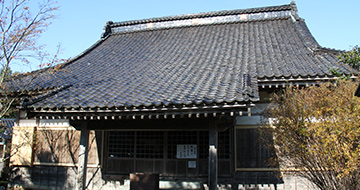
Honkoji (in Miyakawa)
Honkoji Temple in Miyakawa was established by Nichigyo Shonin, with Nichiro Shonin as the first head priest. Within the precinct, you can see relics closely related to Nichiren (exiled founder of the Nichiren School of Buddhism): including the "Shamen-ishi", a seating stone where Nichiren Shonin seated himself when his lead disciple Nichiro Shonin delivered and revealed an amnesty letter from Kamakura; and "Kesagake no Matsu," a pine tree where Nichiren hung his monastic robe.
Kuninaka area -
 Shrines and Buddhist Temples
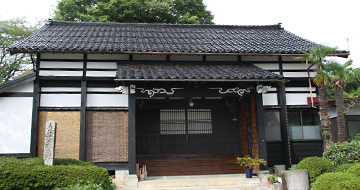
Honkoji Temple (in Izumi)
Honkoji was founded in 1310 by a Buddhist monk Nissho Shonin, who became a strong believer of Nikko Shonin. It sits in the neibourhood of the ruins of Kuroki Palace, where Emperor Juntoku used to live. The temple treasures a wood-carved standing statue of Seikannon (Goddess of Mercy), a designated National Important Cultural Property, which is one of the four statues that Emperor Juntoku brought with him from Kyoto. The temple also has a Mandala (Sado City's designated Tangible Cultural Asset) drawn by Nikko Shonin, who was a leading disciple of Nichiren Shonin (founder of Nichiren School of Buddhism exiled to Sado).
Kuninaka area -
 Noh Stages
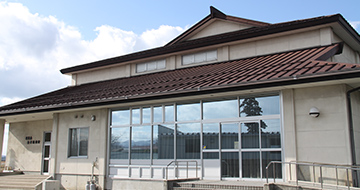
Hori Kinen Kanai Nohgakudo
Kanai Nohgakudo is a Noh theatre located in the Kanai area, which is known as Zeami's place of exile. The theatre hosts a variety of events, including Noh performances, throughout the year. The indoor stage is arranged with seating areas set up on three sides. It consists of a 6-meter mainstage constructed from Japanese cypress, an approximately 10-meter long hashigakari (ridgeway), and a kagami-ita (back wall) with a painting of a pine tree. Kanai Nohgakudo was built on the former site of the residence of Mr Jibu Hori and his wife, who were honourary citizens of the former Kanai Town. A statue commemorating their contribution to their hometown stands within the grounds.
Kuninaka area -
 Shrines and Buddhist Temples
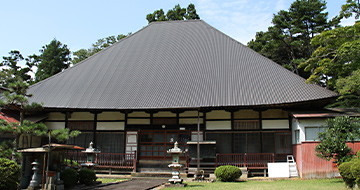
Jinguji Temple
The bronze bell owned by Jinguji Temple is designated as a National Important Cultural Property. The bell was originally offered to Shokoji Temple (Hayoshi, Sado) at the end of the Kamakura Period, to wish Nobutoki Hojo (governor of Sado) peace and good luck in the war. According to the inscription carved on the bell, it was cast and dedicated in 1295. When Haguro Shrine was abolished in 1868 on the order of the separation of Shintoism and Buddhism, the followers of Jinguji Temple purchased the bell and dedicated it to Jinguji Temple. The graceful appearance is marvellous.
Kuninaka area -
 Shrines and Buddhist Temples
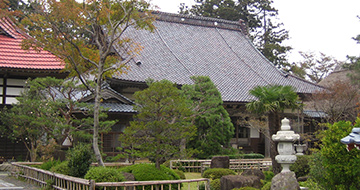
Jissoji Temple
It is said that Nichiren Shonin, founder of Nichiren School of Buddhism exiled to Sado, stood and chanted mantra on this hill every morning, after forced to live in Ichinosawa. The precinct is scattered with a bronze statue of Nichiren, praying to the rising sun whilst thinking of his parents at home in Awa (present-day Chiba Prefecture), Kesagake no Matsu (a pine tree which he hang his monastic robe on), a spring with which he rinsed his hands, and so on. Also, "Sanko no Sugi", a gigantic cedar tree over 1,000 years old (Sado City's Designated Natural Monument) stretches its branches.
Kuninaka area -
 Noh Stages
Kamo Shrine Noh Stage
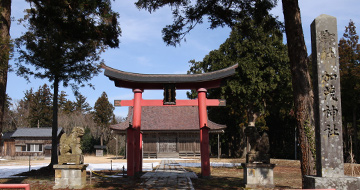
Kamo Shrine was established after Yoshitsuna Minamoto (also known as Jiro Kamo) was exiled to Sado in 1109, by dividing and re-enshrining the gods of Kamo Shrine in the ancient capital city of Kyoto, where he had his coming-of-age ceremony. Transferred from the original location to where it stands now, the shrine buildings were reconstructed in 1694. This shrine considers fowls to be divine messengers, so the buildings have wood-carved nosings shaped like fowl and votive panels with a fowl motif which are dedicated to the shrine, including the Giant Fowl Votive Panel (a City Designated Tangible Cultural Property). At the back of the shrine, there is a free-standing Noh stage representing Sado. The Noh stage at Kamo Shrine is one of the Four Noh Stages in the Kuninaka Area, four prestigious Noh stages where performances were regularly held, including the one at Nyakuichioji Shrine (Sawata Nakahara), Daizen Shrine (Mano Takeda), and Ushio Shrine (Niibo Katagami). Evening Noh performances are held annually in August.
Kuninaka area -
 Shrines and Buddhist Temples
Keikuji Temple
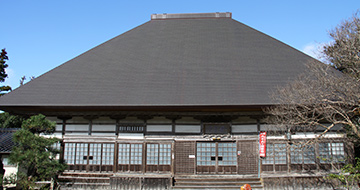
Keikuji Temple is a temple of the Shingon School (founded in 807) with Dainichi Nyorai (Mahavairocana: supreme Buddha of the Cosmos) as the main object of worship. The name of the temple "Keikuji (written as 慶宮 in Japanese) derives from the lore that Emperor Juntoku's eldest daughter, Princess Keishi (慶子), spent her life here. The Princess worshipped Fukurokuju Sonten (God of Longevity), so a master artist, Mahori Hogan Yoshitaka, donated a painting entitled "Jingo (divine protection) Fukurokuju". Keikuji Temple is one of the temples on Sado's Seven Gods of Fortune pilgrimage route. Hasso (eight patriarchs) Hall, equipped with an octagonal shrine with a rotational system, is one of a Niigata Prefecture's Tangible Cultural Assets.
Kuninaka area -
 Shrines and Buddhist Temples
Konponji Temple
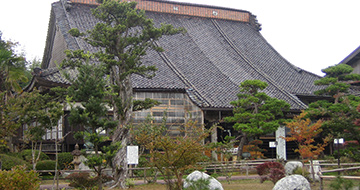
The Sanmaido Hall within the grounds of Konponji Temple is reputed to be the place where Nichiren (a Buddhist monk and the founder of the Nichiren School) had a debate with monks from other schools, and authored Kaimokusho (The Opening of the Eyes). It is one of the sacred places for the Nichiren school, along with Myoshoji Temple in the Sawata area, where Nichiren wrote Kanjinhonzonsho (The Object of Devotion for Observing the Mind). Konponji Temple is a temple complex consisting of twenty-nine buildings and halls on an area of approximately 56,200 square metres. Included on the grounds are Soshido Hall (named after its founder) and the Main Hall, constructed and donated by wealthy gold-mining engineers in the Edo Period (1603-1867).
Kuninaka area -
 Heritage and Relics
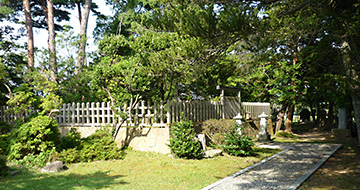
Kuroki Palace
Kuroki Palace is the ruins of the residence where Emperor Juntoku lived after being exiled to Sado as an alleged mastermind of the Jokyu Disturbance in 1221. The shabby palace building constructed using rough-hewn timbers was called Kuroki (black wood) Palace. The present-day mound has been maintained since the Meiji Period (1868-1912), after Kenkichi Kawakami, a local, proposed it necessary. The grounds are covered with many pine trees, including one planted by Emperor Showa, and there are also monuments inscribed with poetry by Mokichi Saito and Hiroshi Yosano.
Kuninaka area -
 Heritage and Relics
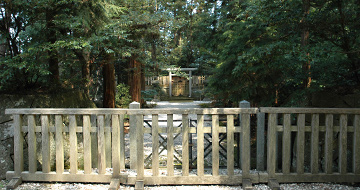
Mano Goryo Mausoleum
Mano Goryo Mausoleum is the official cremation mound of Emperor Juntoku. Emperor Juntoku was forced into exile on Sado when he lost the Jokyu Disturbance. After twenty-two years, he passed away in 1242, at the age of forty-six. His body was cremated the following day, and trees of pine and cherry were planted on the site to mark that which is the present-day cremation mound. His ashes were returned to Kyoto the following year. They were buried near the imperial graveyard of his father, Emperor Gotoba. The cremation mound is handled as an imperial mausoleum under the management of the Imperial Household Agency. The nearby Manogu Shrine enshrines Emperor Juntoku.
Kuninaka area -
 Shrines and Buddhist Temples
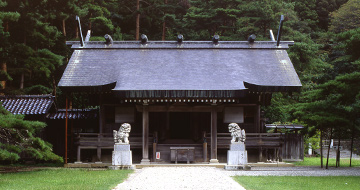
Manogu Shrine
Shinrinji Temple used to look after the cremation mound of Emperor Juntoku. Through the religious reform movement (which promotes shinto and destructs Buddhist temples) in the Meiji Period (late 19th century), Shinrinji was recognised as a prefectural shrine in 1874 and renamed it as Manogu Shrine. Along with Emperor Juntoku, it enshrines Michizane Sugawara (statesman worshipped as a god of learning) and Suketomo Hino (disgraced court noble exiled to Sado). The present shrine buildings were erected in 1920. Torii Gate, Shinkyo (sacred bridge), Shinmon Bridge, and shrine office were newly built, and the sanctuary was enlarged with an extension of the approach. Manogu Shrine treasures a single edged dagger, a ink stone, a fan, a suspension vase, and so on, which are considered as mementos of Emperor Juntoku.
Kuninaka area -
 Other
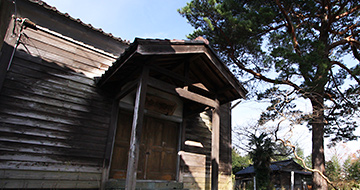
OtherMeiji Kinendo Memorial
Meiji Kinendo was founded by Ryokan Honjo, a Buddhist monk of Tokushoji Temple, to comfort the souls of Sado Islanders who died for their country in the First Sino-Japanese War, and is funded by donations. Later, the souls of the dead in the Russo-Japanese War, Japanese Siberian Intervention, and Manchuria Incident were enshrined here, too. A board inscribed by calligrapher Banko Yoshida with the words of Meiji Kinendo, is hung in front, and the hand-written notes of Field Marshal Iwao Oyama, Katsu Kaishu (a naval officer and mediator in the Meiji Restoration in 1898), and Marshal Admiral Togo are hung inside. A graveyard for Russian navy crews also exists within the grounds.
Kuninaka area -
 Shrines and Buddhist Temples Noh Stages
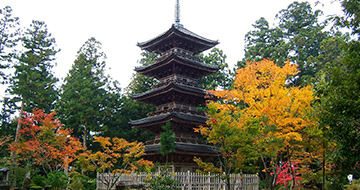
Myosenji Temple
Tamemori Endo (Abutsubo Nittoku Shonin) served Nichiren upon being exiled to Sado and became an avid believer of the Hokke mantra. Together with his wife, Sen-nichini (a Buddhist nun), he opened his residence as a temple in 1278, and this is said to be the origin of Myosenji Temple. The temple used to be a residence of the Takeda Honma clan, deputy governor of Sado, and the ambience of a castle still remains. On site stands the only five-story pagoda in Niigata Prefecture, as well as the grave of Suketomo Hino, who was forced into exile on Sado after the Shochu Incident.
Kuninaka area -
 Heritage and Relics
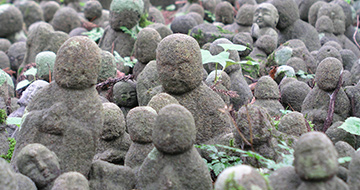
Nashinoki Jizo (Statues of the Bodhisattva)
A jizo (stone statues dedicated to local deities) hall is located on the Nashinoki Pass on Prefectural Route 65 (the former Akadomari trunk road), which passes through the Kosado Mountains from Toyota in the Mano area. There is a jizo statue installed to wish for children's convalescence, and small statues of migawari jizo (who takes the place of people) dedicated as tokens of appreciation after prayers have been answered. The number of jizo statues, also called Koboshi (young Buddhist monk), adds up to thousands, and they surround the hall. Jizo Festival is held annually on 24 August. Locals stay overnight there chanting Shingon mantra the night before.
Kuninaka area -
 Heritage and Relics
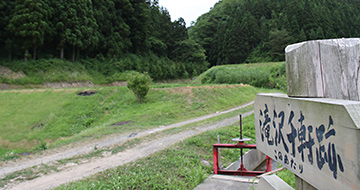
Niibo Ginzan Silver Mine
Situated in Okuyama, which is a releasing point for toki (the Japanese crested ibises), Niibo Ginzan Silver Mine, also known as Takizawa Ginzan Silver Mine, first produced silver around the same time as Tsurushi Ginzan Silver Mine. Although records and a pictorial map from the Edo Period (1603-1867) remain to this day, little is known about this silver mine, including the year of its discovery. Sparsely inhabited today, in the olden days the surrounding area prospered so much that it was called "a town with 1,000 houses." Mining structures, including "Hyakumai Mabu (pit)" and "Ogon Mabu (pit)," still remain.
Kuninaka area -
 Shrines and Buddhist Temples Noh Stages
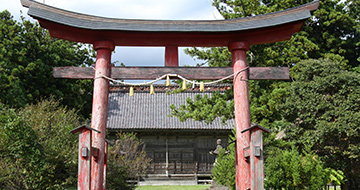
Nikuu Shrine
The site where Nikuu Shrine stands used to be a temporary residence, built by the Kamakura Shogunate at the birth of the second daughter of Emperor Juntoku, Imperial Princess Chushi. In honor of the wild irises ("shobu," in Japanese) in full bloom, Emperor Juntoku named the residence Shobuden (literally: iris residence). Dedicated to Princess Chushi, who passed away at the age of eighteen, the shrine buildings were constructed as Nikuu Daimyojin (a shrine) during Emperor Gofukakusa's reign (mid-13th century). Both Shobuden, which enshrines the hair of Princess Chushi, and the graveyard, under management of the Imperial Household Agency, stand within the grounds. There is a Noh stage, too, which has a thatched, hipped roof and is situated, with woods at its back, to the southeast of the main building.
Kuninaka area -
 Shrines and Buddhist Temples
Obuse Shrine
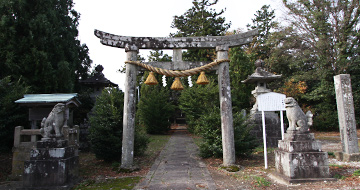
Past the historic Komainu guardian statues, which are considered to have been created by masons in the Tsubakio village, the path opens out onto a vast precinct wooded with oak and Machilus trees. The shrine was reputedly established by the manor lord of Nishimikawa, Honma Yamashiro Nyudo, in the Muromachi Period (1392-1573). The object of worship is the Mikeishi stone enclosed with a stone fence at the back of the main hall. It is regarded as a sacred place where gods descend, and rituals are carried out. Komochimagatama, comma-shaped ornaments with small magatama, are unearthed from the surrounding ground, and Obuse Shrine is highly valued as an ancient site of rituals.
Kuninaka area -
 Folklore
Otowaike Pond
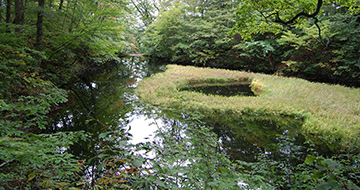
Take a stroll (about 600 metres) along a trail starting at a signboard on the street around Odaira Highland on Osado Skyline, and you will find the mysterious Otowaike Pond enclosed in woods of beech and Mongolian oak. A natural pond deep in the mountains, Otowaike Pond is an important area (together with the surrounding natural forest), and has been designated a Niigata Prefecture Natural Monument. In the middle of the pond, there is a floating bog, one of the largest of its kind in Japan, with over twenty species of plants, including mosses of Polytrichaceae and Climaciaceae, growing naturally upon it. There is a heart-shaped hole in the middle of the bog, which is considered to be the life-line of the islet, and is also thought to induce romantic ambience. The name of this pond is derived from lore, which says a young woman named Otowa was loved by a gigantic serpent, the master of the pond, and committed suicide by throwing herself into the water.
Kuninaka area -
 Other
OtherSado Daikannon Showaden
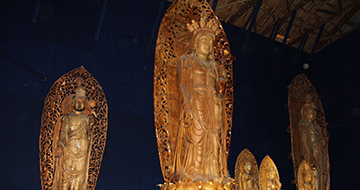
A group of Buddha statues, numbering over 220, is installed in one corner of the Nakaoku area. The main image of Buddha is the Eleven-Headed Kannon Bosatsu a.k.a. Sado Daikannon (Ekadaśamukha), which was erected in 1970, and initiated by Ryukai Yamaguchi, the 24th generation of head priests at Ishina Seisuiji Temple. This huge statue, more than seven metres tall, is made from the single trunk of a Japanese cypress tree over 2,200 years old. It is said that this is the world's largest wooden Buddha statue.
Kuninaka area -
 Shrines and Buddhist Temples
Sado Kokubunji Temple
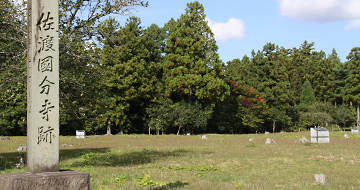
Sado Kokubunji Temple is one of the provincial temples which were founded in each province on the order of Emperor Shomu. The construction of the temple was completed in 764. Kokubunji Temple was one of the first temples built in Sado, and was a rare example of temples with tiled roofs in the Hokuriku Region. It was burnt down several times after being struck by lightning, as well as catching fire, and then reconstructed. You can see a row of cornerstones from Kondo Main Hall, cloisters, Chumon (middle) Gate, Nandaimon (great south) Gate, a pagoda and Shindo Hall all within the grounds.
Kuninaka area -
 Shrines and Buddhist Temples
Sado Kokubunji Temple
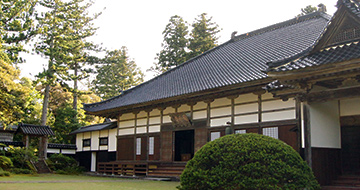
Considered to have been established in 764, Sado Kokubunji Temple (provincial temple) was burnt down several times after lightning strike and great fire. The present-day Kokubunji Temple is located to the east of the old site. The year of establishment is not clearly known, but it is said to be the early Edo Period (early 17th century). Within the grounds lie the main hall as well as Niomon gate with a pair of statues of Buddha's guardians, Rurido Hall, Bell Tower, and so on. The main image of Buddha, a wood statue of Yakushinyorai (Bhaisajyaguru: the Buddha of healing and medicine) survived fires and is installed in the storehouse.
Kuninaka area -
 Shrines and Buddhist Temples
Seisuiji Temple
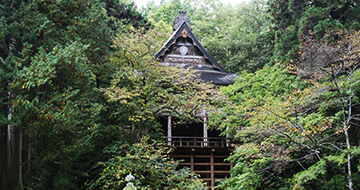
Under Emperor Kanmu's ordinance, Seisuiji Temple was founded in 808 by Ken'o Hoshi, a Buddhist monk who came from Kyoto on a missionary tour. There is Guzeden (literally: salvation) Hall, imitating the wooden stage at KiyomizuderaTemple (written in the same characters as Seisuiji: 清水寺 in Japanese) in Kyoto, but the main object of worship is 1,000-armed Kannon Bosatsu (Guanyin: Goddes of Mercy), also in imitation of Kiyomizudera Temple. Enmeizenzaijurosonten (the god of longevity) is worshipped at this temple, too, and a painting called, "Zenzaijurojin," by Mahori Hogan Yoshitaka, a master artist, was donated. Seisuiji Temple is one of the temples on Sado's Seven Gods of Fortune pilgrimage route.
Kuninaka area