


- View
- History & Places of Interest
- Sightseeing
- Experience
- History & Places of Interest
- Nature/Scenic Spots
-
 Other
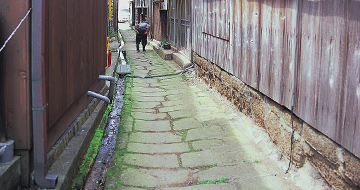
OtherShukunegi
Having been a port since the medieval times, Shukunegi went through the prosperous 17th century brought about by Sado Kinzan Gold Mine, and developed as a kitamaebune port of call for the merchant shipping industry. Facing a small inlet, Shukunegi is characterised by the crowded rows of over 100 houses built with plate walls made from ship planks, and it has been designated as a National Important Preservation Area for Traditional Buildings and Architecture. Three private houses are open to the public (admission charges required), and the entire Shukunegi village represents a history of involvement in ship-related industries.
Minami Sado area -
 Folklore
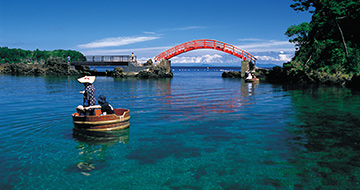
Yajima and Kyojima
Yajima produces good-quality Japanese arrow bamboo (Pseudosasa Japonica).The arrow which Yorimasa Minamoto, a samurai warrior in 12th century, fired to exterminate nue (a frightening imaginary bird in old stories like chimera) in the Tales of the Heike is said to be made from Yajima-grown bamboo. Kyojima is where Nichiro, a Nichiren (buddhist monk)'s senior disciple, drifted to because of a storm, when he brought a discharge paper for Nichiren, who had been exiled to Sado. Kyojima was named after legend that says Nichiro spent a night reading sutras (経 kyo in Japanese). In the beautiful setting with two islets which a red arched bridge connects, you can take a tub boat ride.
Minami Sado area -
 Shrines and Buddhist Temples
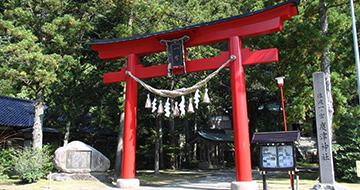
Watatsu Shrine
Watatsu Shrine is dedicated to Isotakeru, a god of Japanese Shinto, and it is worshipped by islanders as a god of traffic safety. This is one of the nine shrines listed on the shrine register of Engishiki (Regulations of the Engi era), and a high class shrine called Ichinomiya. It is said that its precinct, old documents, etc. were flooded out in 1470 and as a result the shrine was relocated to where it stands now. Its origin and history is not clearly known. Watatsu Shrine is a famous spot for the first shrine visit of the New Year, and many islanders visit there from all around Sado.
Minami Sado area -
 Shrines and Buddhist Temples
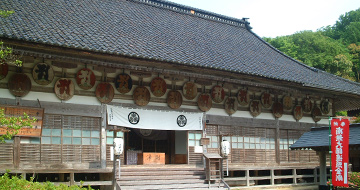
Rengebuji Temple
Rengebuji Temple was established by Kukai (Kobo Taishi, who founded the Shingon school of Buddhism) around 806, since Sado is considered to be an unlucky direction from the Imperial Palace. Rengebuji Temple is said to have been built on the order of Emperor Saga, and is one of the holy places of the Shingon school of Buddhism, along with Kongoji and Murouji Temples. Kobodo Hall, Kondo Main Hall and Kotsudo Ossuary are designated as Japan's Important Cultural Properties, and sixteen other buildings and halls within the precinct are registered as National Tangible Cultural Properties. The hydrangeas come into full bloom in July, and the scenery is breathtaking.
Minami Sado area -
 Other
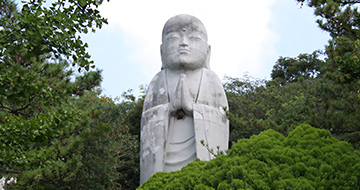
OtherShiawase Jizo Statue
Shiawase (happiness) Jizo, a statue of Jizo Bodhisattva (guardian of children), stands at 17.5 metres high including the base, and it is so huge that it can be seen from a distance. A villager revealed the great desire to build a Jizo statue in 1982, and it was completed in the following year. The white, elegant statue contrasts fabulously with the deep green at the foot of mountains in the Togami area. Past the Sanmon main gate, there is a hall of Jizo, where a variety of Jizo statues are installed. Just a short distance from the Jizo statue lies Iwayasan Cave.
Minami Sado area -
 Heritage and Relics
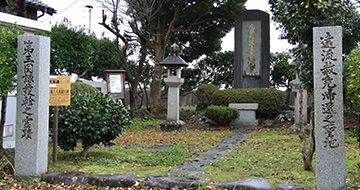
Nichiren Shonin's Namidaimoku Monument
Namidaimoku Monument (literally means wave mantra) stands in the shore of Maura, where Nichiren Shonin, founder of Nichiren School of Buddhism exiled to Sado, departed from Sado after pardoned by the Kamakura Shogunate. According to the lore in the area, when Nichiren put his palms together and prayed to the sun aboard a boat offshore, seven letters of Namu Myoho Renge Kyo (南無妙法蓮華経) appeared in the waves. Closely related to Nichiren Shonin, the Maura area has many legends, and is dotted with sacred places including Nichirendo Hall, Nichiren Cave, etc.
Minami Sado area -
 Heritage and Relics
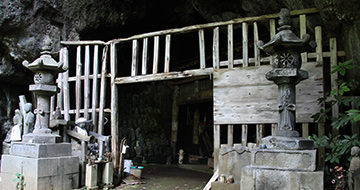
Iwayasan Cave and Buddha Statues
There is a sacred cave in the middle of Mt Iwaya at the back of Shukunegi Village. Various Buddha statues are carved into the surface of the rock. There are eighty-eight stone statues of Buddha, imitating the eighty-eight temples of pilgrimage in Shikoku. The place is called "Iwaya-san" by locals. Worshippers stay overnight in the cave, and practise "Nemari Henro (sitting pilgrimage)" discipline, chanting mantras and pilgrimage songs while seated.
Minami Sado area -
 Shrines and Buddhist Temples
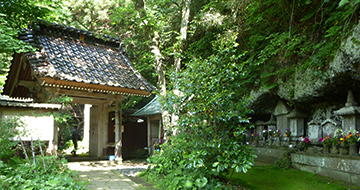
Shokoji Temple
An ancient temple tucked away in the back of the Shukunegi village, Shokoji Temple was founded in 1349 as the first Jishu School temple in Sado. On the Sanmon main gate, there still remains a munefuda [an inscription related to the building], written in 1717, and this gate is one of the oldest pieces of architecture in Shukunegi. Shokoji has been enshrining the Tokai Benzaiten (literally means sea-crossing goddess of the sea), since the olden days. It has continuously been worshipped as a guardian deity protecting against shipwreck, and as a goddess of artistry. A master artist, Mahori Hogan Yoshitaka, donated his painting entitled "Tokai Benzaiten" to the temple. Shokoji Temple is one of the temples on Sado's Seven Gods of Fortune pilgrimage route. Within the temple precinct, there is a graveyard of Shuzo Shibata, a Shukunegi-native who studied Western Studies in the late Edo Period (early 19th century), and later drew an elaborate world map.
Minami Sado area -
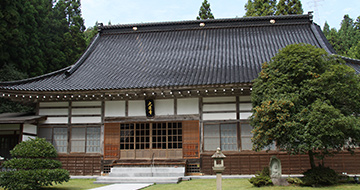 Shrines and Buddhist Temples
Dairenji Temple
Dairenji Temple is a temple of the Soto Zen school of Buddhism established in 1421 as a temple to take care of ancestors of the Honma clan, Lords of Hamochi Castle. The sanmon main gate is the east gate of the castle (Niigata Prefecture's Historic Site), which survived destruction in a siege by Kagekatsu Uesugi (lord of Echigo), and was later relocated. This temple served as accommodations for successive Deputies for Sado and officials in the Edo Period (1603-1867). Within the precinct, there are the 500 Arhats Hall, created by a sculptor of Buddha statues in the Edo Period; Kannondo Hall, enshrining a secret Buddhist icon, Maria-Kannon (Mary statue in Kannon disguise); and Hotei (god of good fortune) Hall worshipped for wealth and happiness. Mahori Hogan Yoshitaka, a master painter, donated his painting, entitled "Amazawa Hoteison." Dairenji Temple is one of the temples on Sado's Seven Gods of Fortune pilgrimage route. Referred to as a temple of camellia flowers, Dairenji Temple is familiar to locals,
Minami Sado area -
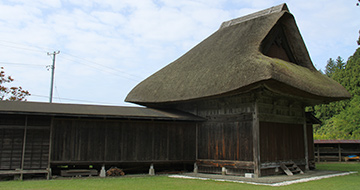 Shrines and Buddhist Temples Noh Stages
Kusakari Shrine
Impressive stone light towers stand along the front path leading to the worship hall. Kusakari Shrine was called "Hachioji Gozutenno" around the middle of the Edo Period (early 19th century), and worshipped as a god of agriculture. It was later called Gion Hamochi Shrine for a time, and then renamed after the old name of the village "Kusakari no Sato," in 1870. Kusakari Shrine is known for offerings of bonfire Noh performances, and a kind of kagura (dance and music dedicated to gods) called "Onimai Tsuburosashi," (designated a Niigata Prefecture Intangible Folk Cultural Asset) performed at Hamochi Festival held annually on the 15th of June. The Noh stage (also one of Niigata Prefecture's Designated Tangible Folk Cultural Assets), which is considered to have been built before the Meiji Period, has a hip-and-gable thatched roof in front and a hipped roof at the back. The structure blends well with the idyllic landscape, whilst projecting a stately ambience.
Minami Sado area -
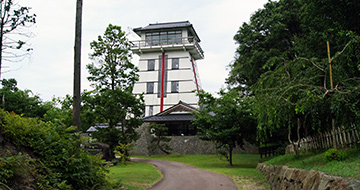 Heritage and Relics
Shironoyama Park
Perched on a hill projecting out into the port, the ruins of the castle built by a castle lord in the late 16th century have been converted into a park for the public. The observation tower serves as an exhibition hall for Akadomari's many folk tales, and bronze sculptures depicting scenes from the stories are on display on each floor. Enjoy a panoramic view in 360 degrees: from the lush mountains behind to Akadomari Port right down the hill, and the Echigo mountain range across the sea.
Minami Sado area -
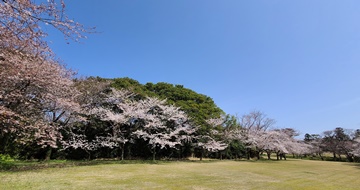 Heritage and Relics
Shiroyama Park
Shiroyama Park is located up on a hill facing the sea. After hiking the steep, cobbled path to the top, a large, open green stretches out before you. The park features trail paths, a resting point, a viewpoint and a monument inscribed with a poem written by Koyo Ozaki, a famous novelist and poet closely associated with the area. The park is filled with seasonal flowers: about 3,000 camellia trees come into full bloom from the beginning of February until early April, 500 cherry trees, dwarf azaleas and hydrangea. Shiroyama Park is a popular relaxing place among locals in the Ogi area.
Minami Sado area -
 Shrines and Buddhist Temples
Kaichoji Temple
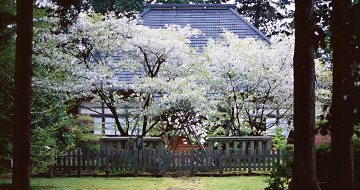
Kaichoji Temple is an old temple of Soto Zen School located in the middle of the hill leading down to Yajima and Kyojima. The two trees of Goshozakura variety of cherry blossoms in front of the main hall are said to have been planted by Emperor Juntoku himself. Each branch produces a blend of single- and multi-layered white flowers, which are very rare, and the cherry trees at Kaichoji Temple are designated as National Natural Monument. Cherry flowers are in bloom from late April until early May.
Minami Sado area -
 Shrines and Buddhist Temples
Zenchoji Temple
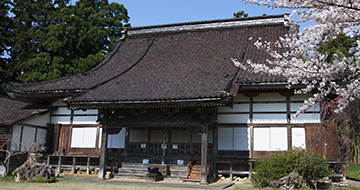
A walk up the gentle slope, with Akadomari Port in the background, will lead to Zenchoji Temple on the heights, a temple of the Shingon School. It was reputedly founded circa 827. Once every thirty-three years, the main image of the temple, the Shokanzeonbosatsu (Aryavalokitesvara) statue is revealed, which is a lost-wax casting work of the first generation of Rando Miyata. Zenchoji is known as the temporary residence of Tamekane Kyogoku (a court noble) for six years, and in connection with his long-aspired return to Kyoto in 1303, the hidden statue at the upper temple has been worshipped in the name of Kikyo ("coming-home") Kannon. In addition, Mahori Hogan Yoshitaka, a master painter, donated a painting entitled "Kyogoku Bishamonten (Vessavaṇa)". Zenchoji Temple is one of the temples on Sado's Seven Gods of Fortune pilgrimage route. Bishamonten is a god with wisdom and valor, as well as, a god of treasure and happiness, and has been steadfastly worshipped to this day.
Minami Sado area -
 Shrines and Buddhist Temples
Kobie Shrine
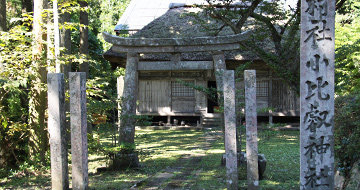
Kobie Shrine used to be a shrine for enshrining the tutelary deity that protected Rengebuji Temple, and was located within the precinct of the temple. It was later separated from the temple, and became a village shrine in the Meiji Period (1868-1912). The stone-built torii gate and main hall, enclosed in an ooiya (a layer of building covering the building inside), are both registered as National Important Cultural Properties. According to the inscription carved on the torii gate, the gate was constructed by Kaiyu, the head priest of Rengebuji Temple, with offerings from Nagayasu Okubo, the Deputy for Sado (later the first Commissioner for Sado) and his brother, Yasumasa Okubo. The thatched worship hall hosts a ritual every February, called "Ta-asobi (rice field work) Shinji," to pray for a good harvest.
Minami Sado area -
 Shrines and Buddhist Temples Noh Stages
Osaki Hakusan Shrine Noh Stage
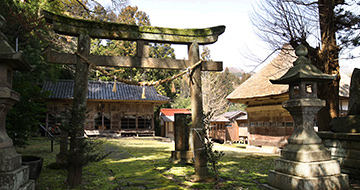
The Osaki community is located up the Hamochi River, which runs through the mountains. Here, the tutelary Hakusan Shrine stands side by side with Miyamotodera Temple. The neatly-built stone walls are beautiful, and after passing through the torii gate, the worship hall encased in the protective forest comes into view. This serene place symbolizes the Osaki area, where sophisticated nonmaterial culture is being nurtured. Inhabitants in Osaki hand down various performing arts such as Chobokuri (the phallus dance) and Bunya puppet theatre, and are thought to be particularly enthusiastic about Noh performances compared to others in Sado. Comprised of a main stage area and a rear stage area, the Noh stage within the compound has a thatched hipped roof and a main entrance on the gabled side. The wall at the back has the traditional painting of a pine tree, and there is a space to hang the big temple bell that appears in "Dojoji," one of the great Noh plays. In recognition of its role in handing down Noh culture, as well as the value of its architecture, this stage has been designated a City Cultural Property.
Minami Sado area -
 Shrines and Buddhist Temples Noh Stages
Kodomari Hakusan Shrine Noh Stage
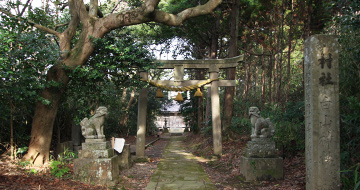
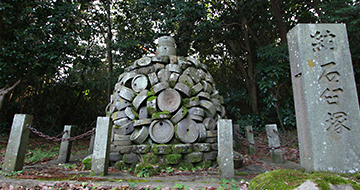
Sitting along Route 350, Kodomari Hakusan Shrine features a well-kept precinct and buildings. The shrine is believed to have originated from a small shrine built by a samurai warrior of the Taira clan, who was defeated by the Minamoto clan in the late 12th century. Kodomari flourished as a masonry center along with the adjacent Tsubakio community in the Mano area. Spectacular lion-dog statues welcome visitors to the precinct, which is known for its mound of millstones, where ones that were no longer in use were once collected from households and dedicated to the shrine. Repaired in 2012, a Noh stage stands to the right of the shrine building. The stage is comprised of main and rear stage areas, and is equipped with a chorus area and a "noble passageway" (where nobility could pass without bowing), as well as a space to hang the big temple bell that appears in "Dojoji," one of the great Noh plays. The wall at the back has a painting of a pine tree, and the one on the east side has a painting of bamboo. The passageway connects the stage and the room behind the curtain where actors prepare, and that room is attached to the worship hall. This Noh stage is designated a City Cultural Property.
Minami Sado area -
 Heritage and Relics
Ishiusuzuka (millstones mound)
Kodomari in the Hamochi area prospered from masonry, together with the adjacent Tsubakio area in Mano. Masons in Kodomari also gained a widespread reputation as sculptors of Buddhist stone statues. Millstones used to be one of life's necessities, but with the progress of the times, they slid into obscurity. The mound of millstones was founded by locals to express regret. In 1977, millstones at each household were collected and and then dedicated to Hakusan Shrine in the area.
Minami Sado area